Showing posts with label writing process. Show all posts

Sunday, June 03, 2012

John Cage: The Excitements of Boredom


I love John Cage for his appreciation of boredom, if not his indulgence in it. Every artist must reckon with the lulls of life in his or her work, but most inject a variety of entertainments into a storyline, smoothing any bit of necessary banality with candy droppings of mindless flow, the promise of action rising. Ta da! Not Cage.

Once, before giving a lecture at Harvard (and a Cage lecture was never just a lecture, but a metaphysical performance), he unapologetically told the audience they were likely to be bored, but that they should view it as an opportunity.

He composed music with such disregard for audience expectations as well, and in so doing became the musical father of everything from punk to techno to minimalism.

In this age of twitches—people reaching for phones to check status updates, tweets, and emails—our lives are quite filled, yet somehow tend to be unfulfilled. Cage would say we need to listen to the emptiness instead of trying to fill it.

I just finished John Cage’s biography, Begin Again, so I’ve been pondering his definitions of sounds and silence and harmony and disharmony, his wonderful embrace of contradictions.

It’s rare that an artist’s work requires the retraining of one’s way of experiencing art itself, but Cage’s compositions not only jarred the public’s sensibilities in his time (the greater part of the 20th century), but still present a challenging dare decades later.

Cage cherished dissonance and happenstance, dramatizing the sounds that fill our lives in all of their random fecundity. His music was a philosophical statement, a confrontation, rather than a frolic or a diversion.

In his most famous piece, 4’33,’’ a pianist walks on stage to play a piece, sits erectly at the piano, adjusts the sheet music, and pauses for four minutes and 33 seconds. In that intense silence—which isn’t truly silence—sound is transformed. Each inhale and exhale, each mysterious scritch and scratch or stray car horn, becomes part of the musical experience. Expectations are flipped as we explore an absence that is also a presence. Mysteries abound.

By focusing on disruptions rather than the connective tissue of a narrative, he obviates the crescendos and diminuendos of music, and his work actually becomes an odd meditation on those spaces of narrative—traditional harmony—not present.

“I didn’t want the mind to be able to analyze rhythmic patterns,” Cage said of one piece. A patterned universe is one with promises of cohesion, a plan, after all.

Instead of the “intention” that drives most artists, Cage created by “non-intention,” relying on the chance guidance found in the I Ching to guide compositions and performances. At one performance, he even handed out programs with different descriptions so that everyone would view the performance through a different lens.

Dissonance held the most interesting beauty to him. With his famous “prepared pianos,” he twisted objects into piano strings so that each note would be a surprise, and the composition would never sound the same twice. To hell with tuning.

Although he conceded in the end that it was impossible not to have harmony, he defined his harmony as “anarchic harmony.”

“One could say that all sounds make love to one another, or at least they accept one another, in any combination,” Cage said.

All we do is music, in other words, but each sound plays off another in a continuing disjointed abeyance, irresolvable, yet beckoning and wondrous. “I want people to be mystified by what’s happening. The reality of our life is mystery,” he said.

I think that deep sense of mystery is what is most important for any artist to honor and revere. Forget the formula, the expectations that can too easily makes work palatable—and suffocate it as a result. In the end, an artist’s dare is what matters.

Some might view Cage’s work as subversive for the sake of subversion, nothing but the high-jinks of a confirmed Dadaist, but Cage religiously and methodically wove a fragmentary, relativist aesthetic with roots in Einstein’s declaration that “there are no fixed points in space.” Cage’s music truly spoke to a plurality of centers, which resonated with him primarily as a Buddhist notion.

Because of such a vast and ever-expanding notion of existence, Cage delved into the question every artist should reckon with: What does it mean to be a person of beginnings? Too many artists find comfort in their endings as they constantly riff on the same theme, which gets so boring to their audience if not themselves. (I heard Carrie Brownstein, formerly of Slater Kinney, say in an interview that the band knew what their next album would sound like before they made it, which is why they broke up—good show).

“I try over and over to begin all over again,” said Cage.

An artist needs no other mantra. Because all of life is finding wonder in the void. Each time I get annoyed by a car’s honking, I’ll now think of how Cage might smile at it, even find it playful.

Monday, February 20, 2012

Writing Residencies: A Chance to Write in One's Best Hours

One of the worst things about aging is the inevitable accumulation of responsibilities. That's particularly bad for a writer, who's inclined to not want any responsibilities at all, other than drifting through the vagaries of a tale that must be told.


It's in such a state that I live. I used to structure my life so that I wrote in my best hours, but now I tend to write in my worst hours, after the kids have gone to bed, after I've paid bills, after a couple of glasses of wine, when most sane people are reclining on a couch and watching Downton Abbey.

I try to crowd in my writing, but life tends to crowd out the imagination with muscular, pugnacious insistence. Which is why I started to dream about going to a writers residency in order to truly dream.

I just published an article in the March/April 2012 issue of Poets & Writers to guide writers seeking the idylls of simple peace and quiet: Applying to a Writers Residency: An Expert Breakdown of the Requirements.

I'm too busy to attend a residency this year, but I have hopes for next year. At least now I know the in's and out's of it all.


Thursday, January 19, 2012

On David Milch: Writing with an Oceanic Sense

“Coincidence is God's way of staying anonymous.”

If you listen to any interviews with the renowned producer David Milch, you'll likely hear him say this. I heard it first, however, from Laura Albert (better known as JT LeRoy), who I met quite by coincidence, and have now become writing partners with (perhaps an act of God?). She was a writer on Milch's Deadwood, so she often sends me links to his interviews or passes on his writerly advice.

One can view coincidence within the prism of mathematical probability, and it certainly has a place in such—in some ways we are just numbers, colliding or not colliding, etc.—but even as a bona fide atheist (with a highly mystical bent), I appreciate Milch's view of coincidence as an entrée into understanding our lives.

To view coincidences on such holy ground is to elevate acts, to see life as a grand quilt, all of us woven together—“together” being the key word. When coincidence happens, we must pause and reflect on the chain of events. We must interpret actions, size up who we are, what we want.

This isn't an essay about new age matters, however. It's an essay about being a writer. Being a writer is the most precise metaphor for being a human being that I know of. We are stories. We are revisions of stories. We are stories in the making. We are a series of coincidences that demand interpretation.

Milch is compelling as a raconteur, one who has the necessary distance to be both charmed and appalled and endlessly intrigued by some of the stories he's lived. Milch constantly calls upon the cosmic consciousness when he speaks of writing, something not only beyond the self, but something, a truth, that can only be reached by abdicating oneself. In this way, much of his perspective resonates with Buddhism, although he's more likely to quote the Bible.

When Nietzsche declared that God was dead well over 100 years ago, it began an age of existential isolation, perhaps especially for artists, who burrowed into their modernist cocoons. Milch disagrees with creation in isolation, however. “The modern situation is predicated upon the illusion of the self's isolation–that business of I'm alone, you're alone, but we can bullshit each other when we're fucking or whatever else, but the truth is we are alone. Right? Well, I believe that that is fundamentally an illusion,” he said in a 2005 profile in the New Yorker.

Such a belief puts an interesting frame on Deadwood, a show that places a crew of mostly heartless exiles together in a practically lawless place, all of them tied in one way or another to gold, hardly a substance that brings people together in loving connection. Milch says the show “is about individuals improvising their way to some sort of primitive structure.”

It's a fascinating narrative premise to portray the wild West in—quite the opposite of a writer like Cormac McCarthy, who writes in the vein of Milch's beloved William Faulkner, but accentuates how the wrath of violence trumps any civilizing urges.

I'm interested in how Milch comes out of the “primitive structure” of self to develop stories layered through the lenses of so many characters. He hearkens back to William James, not Henry, who said in The Variety of Religious Experiences that “every vision that ever came to anyone is prefaced by a sense of the dissolution of the self.” Milch says, “it's the fragmentation of ego that allows what he called the oceanic sense to flow in.”

I'll posit that this is impossible for most writers, who tend to write more and more with their egos, as if their egos are a prized fastball. Milch isn't always beyond such a state either, but he says that “what writing should be is a going out in spirit.”

Every writer reads about subtext and characterization, tone and point of view, dialogue and plot—but what about "going out in spirit"? I think of Hemingway's dictum to “write one true sentence.” Such a simple rule on the surface, but one that must be pondered like a zen koan. I've found as a writer that it's easier to write untrue sentences, just as it's easier to live an untrue life—imitating others rather than genuinely creating—no matter the toll on the soul. One must be highly attuned to the truth and quite brave to represent it and delve into it and live it.

In the case of Deadwood, Milch did the research, then suppressed his self and let the visions come. “Visions come to prepared spirits,” he says.

Milch writes his visions in a writing process that most writers can't do, in a roomful of a various people he's brought in for inspiration (a motley crew of rodeo cowboys and yahoos in the case of Deadwood) and he channels characters, dictating the story as he lies on the floor. The act of writing is literally a “going out in spirit,” for him.

“All I want to understand is the mind of God,” said Milch, quoting Einstein. “Now, I don't want to understand it; I want to testify to it. I believe that we are all literally part of the mind of God and that our sense of ourselves as separate is an illusion. And therefore when we communicate with each other as a function of and exchange of energy we understand not because of the inherent content of the words but because of how that energy flows.”

My best writing happens with such a sensibility—when I feel connected with others, when I am writing to and for others, with a sense of touching them, whether real or imagined, it doesn't matter. But it's more than the concept of audience—it is about the relinquishment of self. Like Milch, I believe that the self clouds or blinds vision, so becoming a good writer and becoming enlightened essentially go hand-in-hand. It's the ultimate feeling of opening up, giving oneself away, an act of generosity rather than the stinginess of ego.

That's what is key in writing for a muse—the acts of generosity and connection guide one's words. The writing isn't about the self so much as it is about a mystical spiritual connection, which has to be honored and revered as much as any God, for it is, in the end, a pathway to the sacred.

Wednesday, December 21, 2011

Writing in Fragments

Sometimes you can shape your life to the cadences of your creativity. Sometimes you have to shape the cadences of your creativity to your life.

When I first decided to become a writer, at the recklessly young age of 20, I embraced Hemingway's preferred writing rhythm: to wake early, write for two or three hours, until the writing juices were spent, and then not think about what you've written the rest of the day–a strategy to replenish those precious creative juices, to let thoughts percolate in the unconscious.

I constructed my life so that I could write in such a manner for several years (waiting tables at night so that my mornings were perfectly pristine for writing), and I loved that life. I'd love to live that life now, in fact, but I have children now, and I have to work 9-5 jobs, the kind with health insurance, so my time to write becomes ever more narrow and unpredictable, a matter of fragments, or even fragments within fragments.

Instead of writing in my best moments, I write mostly in my worst moments, late at night or during the intermission of a child's performance or in the five minutes I have before booting up the computer in the morning (I probably spend a little bit more time with my kids than Hemingway did).

This is all to say that I'm constantly scheming and rethinking my writing process, if not the actual products of writing itself.

I recently flipped through Francine Prose's Reading Like a Writer in search of random writerly guidance and she commented how the best writers create their minor characters in just a few deft strokes. As an example, she showed how Jane Austen “speedily and almost offhandedly dispatches” Mr. and Mrs. John Dashwood.

“He was not an ill-disposed young man, unless to be rather coldhearted, and rather selfish, is to be ill-disposed: but he was, in general, well respected; for he conducted himself with propriety in the discharge of his ordinary duties. Had he married a more amiable woman, he might have been made still more respectable than he was: he might even have been made amiable himself; for he was very young when he married, and very fond of his wife. Mrs. John Dashwood was a strong caricature of himself;–more narrow minded and selfish.”

Capturing a character in just a few lines is a difficult thing to do, but it plays into a writing project I just started. In tandem with the literary journal I began earlier this year, 100 Word Story, I've been trying to write one 100-word story each day. It relieves the tension and frustration of not being able to truly delve into the writing life, but it also does a number of things:
  • Makes me pause and notice things in a way that I ordinarily wouldn't because I have to conjure a new story each day;
  • Makes me focus on a condensed, succinct piece of writing–no fluff, no extra words, no padding;
  • Helps me keep the writing momentum going–and even develop future longer pieces (I look to some character sketches as the foundation for future NaNoWriMo novels);
  • Allows me to have a number of prose poems and short shorts to be able to submit to magazines–so I can submit more frequently, instead of waiting months to finish a 20 or 25 page story (literary journals are more likely to publish shorter pieces anyway) or years to complete my novel.

I've been applying the Francine Prose quote to characters from stories I've written over the years to see how I can distill their characteristics into such a short space. I'm also occasionally taking characters from current longer pieces and writing miniature stories about them. Even if I never do anything with these pieces, they are a way to enrichen my longer stories and extend them in different directions.

It's safe to say that I will probably never again experience my “ideal writing life”–life is rarely so kind–but circumstances often unexpectedly lead one to a better place. I think of Lydia Davis, who decided that she couldn't possibly write a novel as a single mother, so she wrote all of the intriguing short shorts that made her name. Likewise, Toni Morrison, another single mother, finished her first novel by writing for 15 minutes each day after putting her children to bed.

Progress happens in the accumulation of increments. That's where I find my writing faith at the moment. I bow to small things and hope they lead to larger things.

Monday, November 21, 2011

Revision Tip No. 2,043: The Art of Dancing to Guy Lombardo while Drumming to Mingus


I've often heard it said that writing is revising, and that's true in the sense that you're adding layers and nuances and telling details in revision that often aren't possible in the bustle or turmoil or excitement of a first draft. You're making a fine wine in revision, in other words, which takes time, finesse, and sagacity.

Because of this, revision is an art that requires constant scrutiny. You can't just muscle through a revision like you might a first draft. It needs to be a process of challenge, counterpoint, and exploration—all within the malleable structure you've put forth—yet I've found that revision can be the opposite of this. It can tend to become lazy, an exercise in reading more than an exercise in active change.

Here’s what often happens to me when I revise a piece (and I've heard similar tales from other writers). Author writes first draft of story. Author sits down to write second draft of story. Author reads story start to finish making editorial scritch-scratches in the margins. Author types in changes. Rinse. Repeat. Reload.

Hmmm…it's a little bit like dancing a waltz, following the same steps over and over again, feeling the nice rhythms of the music, but unable to add the sorts of flourishes, startling details, absurd moments, etc., that make a story special.

There are a good 2,042 tips about how to revise a piece so that you’re not just pushing a plow through an already plowed row, but I’ve come to like no. 2,043.

Here it is: Instead of reading your story start to finish, don’t read it. Don’t even have the story in the room with you. Don’t have your laptop either. Your dog or cat can stay along with your preferred beverage, but that's it.

The thing is to revise as if you’re still creating, not just refining (as important as refining is). My best moments of creativity happen when I’m not writing within a structure, but meandering—caught in a drift with only the faintest sense of purpose.

So here’s one way of doing that: I grab a few books of poetry, an art book or two, my describer’s dictionary, and I page through them randomly, with some Mingus or Sonic Youth or Calexico or Arvo Part on in the background, and think about my story through all of these influences. I drop in and out of poems, riff on a phrase or a word or whatever comes to mind.

I’m not really thinking of my story, yet I am. I’m tracing moods, dreaming, conjuring, whatever. I write little scenes, character descriptions, single words that I like. It’s all a collage, which for me is the word that defines the best sort of creativity. It’s playful. One thing layers upon another. It’s impossible to make a mistake.

And that’s the crux of a second or third draft—the tendency to want to preserve instead of explore. The curves of a creation are in place, after all, so it’s difficult to want to give them a different shape, which means that a story can tend more toward the rigidity of ossification.

I find when I work outside of the story in this manner, and especially in the slow ease of  longhand, that nothing I write has to make it into the story. Still, I usually create a piquant scene or two, a more lyrical description here and there, and even figure out how to cut some of the bad stuff out.

It’s like a new, exciting kid has just moved next door and I’ve got a fun playmate. We run through the neighborhood without supervision. We feel the sweat on our bodies as if for the first time. We lose our breath from running.

I know that there will be revisions and more revisions, of course—and that sometimes it’s necessary to stay in the rut of the story for refinement’s sake, just to smooth those uneven surfaces. But this is one fun way to challenge a story, hopefully bring it to life in a way that a more workmanlike effort can’t.

On to revision tip no. 2,044, "Taking an Exotic Foreign Vacation to Revise Your Story." I have to admit that this one is my favorite. Although 2,045 has its place: "Marrying Rich to Revise Your Story."

Sunday, June 12, 2011

Laura Albert and JT LeRoy: Mask as Muse


When I came across the Greek maxim “Know thyself” in my college freshman humanities class, I thought it was the key to life.

Then a couple of years later, I decided to become a fiction writer and discovered Hemingway’s dictum to “write what you know.”

Such a thing seemed simple, but it took me another 20 years or so to realize just how difficult it is to “know thyself” or “write what you know”—we’re elusive creatures by design, always changing, seeking, and fleeing.  Writing what you know becomes something like a pilgrimage, a chase scene, a dreamscape, a meditation, and a scientific experiment all in one.

In fact, according to the Suda, a 10th Century encyclopedia of Greek Knowledge, “Know thyself” has contradictory meanings. On one hand, the proverb is applied to those whose boasts exceed what they are, but on the other, it is a warning to pay no attention to the opinion of the multitudes.

I’m traipsing through such thoughts because I’ve been revisiting that crazy, fantastic, compelling “hoax” of JT LeRoy since Laura Albert (aka JT) contacted me when she stumbled on a blog piece (Finally, the Great American Novel) I wrote when the whole scandal went down five years ago.

In case you missed it, JT LeRoy was a young truck-stop prostitute who had escaped rural West Virginia for the life of a homeless San Francisco drug addict. Laura Albert and her boyfriend Geoffrey Knoop rescued JT and helped him get treatment by a psychologist. Then, with the help of literary luminaries such as Mary Gaitskill and Dennis Cooper and others, JT wrote critically acclaimed works of fiction noted for their stark portrayal of child prostitution and drug use.

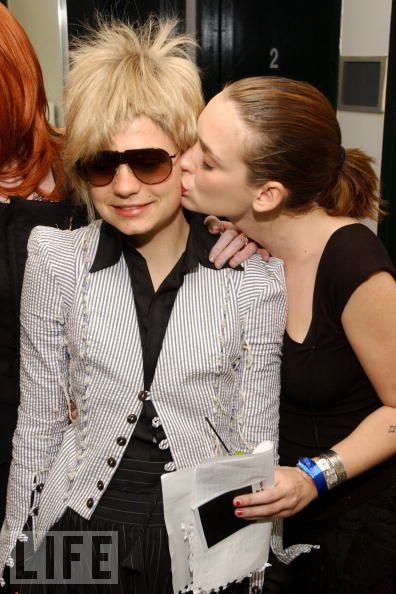
Shy, wounded, reclusive, yet riveting, JT attracted a swirling flock of celebrities like Winona Ryder and Courtney Love—except it turned out that JT was Savannah Knoop, Geoffrey Knoop's half sister, who wore a wig, sunglasses, and a hat in “his” few public appearances. And Laura Albert penned all of JT’s books.

Looking at the photos again, it wasn’t as if JT was disguised with any CIA type of sophistication. Yet people believed that JT was JT, perhaps against their better judgment, for reasons that might tell a larger story (what did they see in JT that they needed to see?).

When New York Magazine and The New York Times uncovered the true story of JT LeRoy, the story turned into a scathing public drama that was the literary world’s equivalent of the press chasing O.J. as he tried to escape in his SUV (except without any blood), with many of JT’s one-time supporters caterwauling, “Shame, shame!” in outrage.

I don’t truly know Laura Albert, but from our recent correspondence I like her as a risk taker who is genuinely trying to represent a “truth” in the world—the task every serious writer takes on. She pursues such a truth more in the vein of Werner Herzog’s notion of “ecstatic truth”—a truth that is the enemy of factual truth in its aim of capturing something more sublime. Herzog says that “to acknowledge a fake as fake contributes only to the triumph of accountants.” And much of our narrow-minded, prudish literary establishment.

I’m not so concerned about the rich and powerful being scammed for what is the equivalent of loose change to them, or whether they had their feelings hurt. What interests me is the nature of writing with such a mask on, and I appreciate the moxie it took to put on such a performance.

“Performance” is the key word here. I like to think of JT’s novels not as just novels, but as part of a larger performance piece—one that put a wispy, vulnerable figure who looked like one part Andy Warhol, one part Michael Jackson, and one part blank slate on stage.

Instead of viewing it all as a swindle, I view it as an act of creation that grew in wild and unexpected ways and became far bigger than could have been imagined. I say “act of creation” because creation seemed to be at the root of it—a rollicking, gleeful, daring, probing, and carnivalesque exploration that in the end reflected our culture in a way that few acts have (I’d trade several National Book Award winners for it all).

And in the end, the fundamental question remains: If you liked the novels when they were written by JT LeRoy, why should you esteem them less when you find out they were written by Laura Albert? Perhaps the work should even grow in stature.

Just read the blurbs for the novel Sarah—blurbs that aren’t your ordinary blurbs churned out for marketing purposes. The authors who blurbed the book—Chuck Palahniuk, Jerry Stahl, Suzanne Vega, etc.—wrote truly imaginative, energetic assessments. They loved JT.

“JT LeRoy’s Sarah is a revelation,” writes Dennis Cooper. “It makes you realize how overused words like original and inspired have become. LeRoy’s writing has a passion, economy, emotional depth, and lyric beauty so authentic that it seems to bypass every shopworn standard we’ve learned to expect of contemporary fiction. This is a novel gripped by an intense, gorgeous, yet strangely refined imagination, and its experience is unforgettable.”

Laura—who might still be one part JT despite the obvious forcefulness of her personality—sent me a video of her recent appearance at The Moth (see below), where she gives her side of the story. It’s interesting to hear how her path to becoming JT wasn’t full of the calculation the press seared into its headlines, but was a mask that opened up a path to a story—a mask created from her own past as an abused child and the tales of others she took in.

Most, if not all, good writers write via a mask of some sort, whether named or unnamed, acknowledged or not. The notion of a single, pure self is antiquated (even the Greeks knew as much in their aphorism). We know ourselves principally through the eyes of others and the ways we seek to be seen. So writers put on guises, code switch, mimic, and dramatize themselves to find the story—and then the reader does the same in seeking to see himself/herself in the text.

Knowledge is a game of storytelling, as akin to fiction as nonfiction. Tell yourself you’re a victim, and you’ll get one storyline and one set of “facts”; tell yourself you’re a hero, and you’ll get another. 

I’ve always been a solitary writer, to my disadvantage. Recently, though, in the act of sharing my writing and writing with readers in mind, I’ve discovered how the context of writing (the cloak of self-mythology you write in, who you want to be seen as) informs and changes the text.

I think of Roland Barthes and his concept of the jouissance, the play, the erotics that occurs between writer and reader. “The text you write must prove to me that it desires me,” he writes in The Pleasure of the Text, claiming that writing is “the science of the various blisses of language, its Kama Sutra.”

The writer seeks a reader, seeks ways to reveal and touch, and will put on any guise available to accomplish those ends, like a good lover. There are many different ways to tell a story (“various blisses of language”), which makes the notion of “write what you know” quite complicated. We write through the “anxieties of influence” of past authors, as Harold Bloom has famously noted, but we also write through the masks we create in pursuit of self.

An outlaw’s attitude is essential. “If a writer has to rob his mother, he will not hesitate; the ‘Ode on a Grecian Urn’ is worth any number of old ladies,” William Faulkner said.

So I invite you to watch the video below and ask yourself whether Laura Albert is a “fake fiction writer,” as she has been called? Is she an outlaw? A charlatan? Does it matter who JT LeRoy is? Who are you when you write? Who do you want to be?


Friday, March 11, 2011

The Notion of a Reader: Poet Jack Spicer

After an odd, misguided lifetime of writing mainly in solitude, I’ve started to share my writing with others. Sometimes just for the hell of it, sometimes to have another simply witness my writing, sometimes with the idea of receiving useful, intelligent feedback—and sometimes for all of the above. The whole experience has given rise to thoughts about what it means to think of writing with actual flesh and blood readers in mind.

I’m more and more convinced that great art and great creations in general (yes, I believe in greatness, at least unless it includes me) are in essence collaborations, even if unwittingly. Would there be a Patti Smith without a Robert Mapplethorpe? A Jack Kerouac without an Allen Ginsburg? A Sartre without a de Beauvoir? A Brad Pitt without an Angelina Jolie (kidding)? And vice versa in all cases.

Life at its best is a constant riff, one idea arising from another in a wild, jazzy ping-pong match where you lose track of whose idea is whom's. That’s art for me, even if you have to shuffle back to your hovel to record it all in mildewed solitude.

Such chemistry is rare, almost divine I’ll venture, whether it’s in the form of a true artistic collaboration or simply the good fortune of finding a trusted reader. But just what makes for a good reader is worth pondering.

Despite going to grad school for creative writing, I’ve had many more bad readers than good ones (hence the years of writing in solitude, I suppose). When John Updike was asked who his ideal reader was, he once spoke of a teenage boy in a library, walking the aisles and pulling books off the shelves, more or less randomly, looking for literary adventure.

But I challenge Updike. His teenage boy is a nice notion, but I don’t want such an abstraction—it seems useless to be so removed from a real person who can receive one’s words.

Likewise, Harold Bloom posits that great writers feel an “anxiety of influence,” that they’re writing in a spirited competition to outdo their literary heroes, dead or alive (yes, a very male competitive notion of creativity).

Again, while I certainly write with influences and voices in my head, they’re more friends than competitors (could this be why I’m not a great writer?).

If love is a desire to reveal and relinquish at the same time that it’s a desire to possess and understand, then a writer wants to find a reader in the same mold. A writer wants to hold another with his or her words, to have a sense that words flow into feelings, that a pause is struck upon another’s gaze of life, if not a transformation.

You might say that the writer’s audience is always a fiction, a projection—as most of life is, certainly—but that’s not to say it doesn’t exist. Again, to pick up the metaphor of the writer as lover, a writer writes for effect, to give pleasure and meaning, to pique interest. It’s only with a loving or inviting recipient in mind that such effects can be achieved.

So what do I want from a reader? I used to think that I wanted a biting critique, a certain regimen for self-improvement, but I don’t think that’s necessarily so valuable. In the end, I want someone who’s fundamentally interested, who I feel wants to read me in that pure energetic and curious way that one person wants to know another.

If I feel that, then I can write to move another. I’ll scrutinize each word, make sure I’ve challenged each scene. I’ll know whether I’ve succeeded just by the enthusiasm of the response, not through any workshop critique (most of which end up as, “I want to know more about….” and more and more and more—sorry to all who've received such bad reading from me, which I'll call "stuck in the workshop rut of response").

I’ll leave the teenage boys looking for books in libraries and the writerly workshop folks to others. The ideal reader is not someone who adores without question, but one who wants to love and be loved, which as anyone who has loved knows, can be a quite complicated scenario. I’d expect nothing less than complexity from any reader. I’d never want a lover who didn’t challenge, scrutinize, dare, and sometimes ignore.

So reader as friend, lover, source of generosity, curiosity, yet intelligent and critical and biting if necessary, or something along those lines. But a real person.

This is all a lead-in to a piece the Bay Area poet Jack Spicer wrote on audience—in the form of a letter to Lorca (an essay on audience with a dead poet in mind, you might say—but an audience nevertheless).

Dear Lorca,

When you had finished a poem what did it want you to do with it? Was it happy enough to merely exist or did it demand imperiously that you share it with somebody like the beauty of a beautiful person forces him to search the world for someone that can declare that beauty? And where did your poems find people?

Some poems are easily laid. They will give themselves to anybody and anybody physically capable can receive them. They may be beautiful (we have both written some that were) but they are meretricious. From the moment of their conception they inform us in a dulcet voice that, thank you, they can take care of themselves. I swear that if one of them were hidden beneath my carpet, it would shout out and seduce somebody. The quiet poems are what I worry about—the ones that must be seduced. They could travel about with me for years and no one would notice them. And yet, properly wed, they are more beautiful than their whorish cousins.

But I am speaking of the first night, when I leave my apartment almost breathless, searching for someone to show the poem to. Often now there is no one. My fellow poets (those I showed poetry to ten years ago) are as little interested in my poetry as I am in theirs. We both compare the poems shown (unfavorably, of course) with the poems we were writing ten years ago when we could learn from each other. We are polite but it is as if we were trading snapshots of our children—old acquaintances who disapprove of each other’s wives. Or were you more generous, Garcia Lorca?

There are the young, of course. I have been reduced to them (or my poems have) lately. The advantage in them is that they haven’t yet decided what kind of poetry they are going to write tomorrow and are always looking for some device of yours to use. Yours, that’s the trouble. Yours and not the poem’s. They read the poem once to catch the marks of your style and then again, if they are at all pretty, to see if there is any reference to them in the poem. That’s all. I know. I used to do it myself.

When you are in love there is no real problem. The person you love is always interested because he knows that the poems are always about him. If only because each poem will someday be said to belong to the Miss X or Mr. Y period of the poet’s life. I may not be a better poet when I am in love, but I am a far less frustrated one. My poems have an audience.

Finally there are friends. There have only been two of them in my life who could read my poems and one of that two really prefers to put them in print so he can see them better. The other is far away.

All this is to explain why I dedicate each of my poems to someone.

Love,
Jack.

Thursday, February 18, 2010

Writing tip no. 3,046: Sam Shepherd and voices and cowboy mouths


Voice. How to hear it, how to speak it, how to write it?

Some are lucky in that voice or voices seem to possess them in such an overwhelming (yet perhaps unforgiving) way. Think Rimbaud, Kerouac, Virginia Wolf, William Faulkner, Malcolm Lowry—all of the mad caps of literature.

But whether voice possessed them like a poltergeist or not, they had to honor the voice, listen to it, give it form. The voice didn’t just speak itself.

This is all to say that I don’t think writers should be too mystical about voice. I don’t think Rimbaud’s “derangement of the senses” is the path, just a path. One might seize upon voice through prayer, or, I don’t know, jogging, crocheting, sipping tea.

Voice is a commitment. To hear it you simply have to privilege listening to it over the din of the other noises in your life.

I’m thinking about voice because I just read the profile of Sam Shepherd in the Feb. 8 New Yorker. It’s always interesting when someone like Shepherd emerges out of nowhere, literally stepping off a bus in New York City in 1963, unread, unschooled, unconnected, and then he writes such a tangle of compelling stories, seemingly without the tortured ambition and wrangling with revisions that others muscle through.

He’s one of those blessed (or cursed) naturals. Because he listened.

“I had a sense that a voice existed that needed expression, that there was a voice that wasn’t being voiced,” he said.

Is there any better definition of the first powerful impulse to be a writer?

“There were so many voices that I didn’t know where to start. I felt kind of like a weird stenographer….There were definitely things there, and I was just putting them down. I was fascinated by how they structured themselves.”

Shepherd’s plays grow out of a certain beat tradition, the words, characters, and structures spawning from his trust in the more intuitive forces of creation.

“You find all the rhythms and the melody and the harmonies and take them as they come,” he says.

Such a raw trust in voice seems absent in most of the stuff I read these days (with the exception of Roberto Bolano). I suppose the easy answer is that we’re living in the age of MFA programs and social networking and email. Authors are well-read and schooled and connected. Our age of writing is very practiced, very intentioned. Stories tend to be neat, not messy. It takes a very brave writer to trust in the voice more than the structure, the sale, the marketing, etc.

I don’t know if that’s right or wrong.

The article includes so many of Shepherds voices as he chronicles “the whacked out corridors of broken-off America.”


People want a street angel. They want a saint with a cowboy mouth.”


Shepherd also provides a nice angle on characterization: “I preferred a character that was constantly unidentifiable.”

An author shouldn’t answer for a character’s behavior, in other words, or at least not entirely. These are the people we’re compelled by in real life—the ones that don’t fit into our expectations. The ones who trouble us.

It fits with a quote I remember reading from Shepherd over 20 years ago: “Always write within a contradiction.”

Voices colliding…

Wednesday, January 13, 2010

Elmore Leornard's writing tips

I just stumbled across this article of Elmore Leonard's "10 tricks for good writing." As fun and interesting as the series of Paris Review author interviews is, I don't think one needs to go much further than this, at least for starters.

1. Never open a book with weather.
2. Avoid prologues.
3. Never use a verb other than "said" to carry dialogue.
4. Never use an adverb to modify the verb "said”…he admonished gravely.
5. Keep your exclamation points under control. You are allowed no more than two
or three per 100,000 words of prose.
6. Never use the words "suddenly" or "all hell broke loose."
7. Use regional dialect, patois, sparingly.
8. Avoid detailed descriptions of characters.
9. Don't go into great detail describing places and things.
10. Try to leave out the part that readers tend to skip.

On the other hand, here's an excerpt from a Paris Review interview with Philip Roth, so the interviews do deepen a list of tips--just a bit:

"Beginning a book is unpleasant. I’m entirely uncertain about the character and the predicament, and a character in his predicament is what I have to begin with. Worse than not knowing your subject is not knowing how to treat it, because that’s finally everything. I type out beginnings and they’re awful, more of an unconscious parody of my previous book than the breakaway from it that I want. I need something driving down the center of a book, a magnet to draw everything to it—that’s what I look for during the first months of writing something new. I often have to write a hundred pages or more before there’s a paragraph that’s alive. OK, I say to myself, that’s your beginning, start there; that’s the first paragraph of the book. I’ll go over the first six months of work and underline in red a paragraph, a sentence, sometimes no more than a phrase, that has some life in it, and then I’ll type all these out on one page. Usually it doesn’t come to more than one page, but if I’m lucky, that’s the start of page one. I look for the liveliness to set the tone. After the awful beginning come the months of freewheeling play, and after the play comes the crises, turning against your material and hating the book"

I'm sure Elmore Leonard might have a snappy retort for Roth, like, never open a book with weather, which is a sort of literary koan if you think about it.

Monday, August 31, 2009

How to Write? The Definition of an Author

I'm reading James Wood's How Fiction Works. It's a somewhat masochistic task. No fault to James Wood, who, after 25 mildly interesting pages, provides a perfectly adept and writerly dissection of the free indirect style--the kind of analysis I literally ate up in my 20s, when I was trying to figure out how to write.

Except that I can't imagine that anyone can truly learn to write while reading such stuff. It's good undergraduate fare for understanding exactly what his title posits--How Fiction Works--but to write the damn stuff, I don't think any author thinks of sentences the way Wood thinks about them.

Wood gets out his scalpel and shaves the words out of sentences to show which words are authorial, omniscient, and which close in on a character's lingo or point of view. He's a good surgeon, but, to get just a bit mystical, I think writers feel their way through a story more than they diagram it in a blueprint (to mix metaphors, of course, because the world is a bunch of mixed metaphors--I've never understood why a mixed metaphor is a bad thing).

In other words, I think James Joyce or Jane Austen could write the sentences he deconstructs without giving a second thought to the labels of style he's obsessed with. Free indirect? Even Joyce, our author of all, is primarily absorbed in just telling the story, like a hunter pulling the trigger, largely by sight and reflex and experience. He just has more mechanisms at hand than some authors do.

I think of Richard Poirier, who was recently profiled in the Times, who said that the most powerful works of literature (to revere the word "literature") become "rather strange and imponderable" over time. The best authors elude readers, take them away from the roads of a story than can be easily charted, rather than mastering something like the free indirect style.

Poirier's definition of "great writers" is those who are tormented and thrilled by "what words were doing to them and what they might do in return." It's a game, a love affair, a war, a religion, a pilgrimage. And then something more.

He said that the act of writing is an assertion of individual power. What an interesting take on this troubling, often debilitating obsession some of us have. To think of it in such a way is such a fresh, and, well, empowering way to think of what is so often marginalized, trivialized, disdained.

Gosh, writing as an assertion of power. Take that. My truth. Like a sword.

I guess this is all to say that one might learn a bit from a book like Wood's, but writers might learn more by thinking about their assertiveness, the keen angles of their perception. That crazy intuitive sense of truth that's so difficult to trust in the din of voices that always militate against a writer's wishes: to write, always, with delusions within arm's reach, hopes in the cupboard.

Think of this sentence. "Struggling for his identity within the materials at hand," they "show us, in the mere turning of a sentence this way or that, how to keep from being smothered by the inherited structure of things."

Who needs the free indirect style? Or rather, who needs to be so conscious of how it works when there's something so much more urgent to wrestle with? (Yes, I sometimes like to see this all as a mythological battle of sorts. Why not?)

Life, after all, is about contradiction, messiness, far more than it is about technique.

Thursday, November 01, 2007

Denis Johnson--All the Writing Advice You Need

Denis Johnson says it all in this brief interview after being nominated for the National Book Award.

What a lovely way to describe his process--"I don't have much interest whether any of my books work or not." If only more writers wrote with such disregard toward their audience, and such regard for the truth of the material.

Here's an excerpt from the interview....

BAJ: Were there moments in your writing process where you worried the book wouldn’t work? If so, how did you press on?

DJ: Well, I've never thought about this before, but now that you ask, it occurs to me I don't have much interest whether any of my books work or not.

BAJ: If there is a common thread among this year’s fiction finalists, it might be that all of the books employ interesting narrative structures and scopes. Although Tree of Smoke moves, for the most part, chronologically through its storylines, you’ve given the reader a sweeping, multifaceted, and expansive narrative. Did you conceive of such scope before beginning the book, or did the symbiotic relationship between the subject and structure emerge more intuitively?

DJ: I'm fond of quoting T.S. Eliot, who somewhere said he was concerned, while writing, mainly "with decisions of a quasi-musical nature."

BAJ: Finally, when you were writing Tree of Smoke, did you have an audience or ideal reader in mind? If so, who?

DJ: I write for my wife, my agent, and my editor.


Monday, September 03, 2007

Malcolm Lowry—Death by Misadventure

Since The Voyage That Never Ends, a collection of Malcolm Lowry’s writing just came out, I have to pause to pay a tribute to one of the best writers ever, and certainly the best alcoholic writer ever (Lowry’s drinking makes Fitzgerald or Hemingway seem like weekend party boys at best).

Here’s Lowry on alcoholism and writing: “With a bad hangover your thoughts are often incredibly brilliant but you can't put them down because you cannot believe yourself capable in such a state of doing a single constructive thing, least of all what your higher self wants to do. ... When you start putting your thoughts down again, that means you are getting over your hangover. But by this time the thoughts are no good.”

That’s a far cry from Fitzgerald’s insistence that he never wrote while drinking (he protested a bit too much to be believable, however).

Lowry’s quote is essentially a riff on Rimbaud’s belief that poets become seers by undergoing a complete derangement of the senses. I’ve placed a bit of belief in Lowry’s theory, or at least I did when I was younger. A hangover can be a wonderful place to write from because it can combine the elation—or the acute embarrassment—of the previous night with the abject pain and/or nervous excitement of the present. Two contradictory states exist simultaneously, which can be the perfect place to write a tragedy or comedy. A hangover jars you out of the mundane, and if conditions are perfect, you can indulge in your woozy, jabbing thoughts and make great art, full of nuance and complexity and counterpoint.

If conditions are right...I wouldn’t aspire to such a state now for anything. I prefer to write with a clear head and a good night’s sleep. Perhaps Lowry should have realized as much when he hit middle-age, but he stubbornly clung to alcohol in the most stubborn, self-destructive ways possible (read his biography for the sordid details of one of his treatments, locked into solitary confinement in a room with an endless supply of liquor and nothing else--most people beggeed to get out after a week or two, but Lowry lasted until the doctor's forced him out). Lowry’s method of writing probably limited him to one great book, but then few have more than one great book in them.

It’s so poetically perfect that Lowry’s death was ruled a “death by misadventure” by the coroner since he was unable to determine whether the lethal combination of alcohol and sleeping pills had been taken intentionally. I think Lowry would have appreciated the phrase. It has a grandiosity about it, a romanticism that he lived by and dispelled at the same time.

Consider this quote from one of his stories:

“I had been looking forward to something anxiously and I called this China, yet when I reached China I was still looking forward to it from exactly the same position. [...] Haven't you felt this too, that you know yourself so well that the ground you tread on is your ground: it is never China or Siberia or England or anywhere else ... It is always you.”

Lowry was so skillful in many ways, but since the subject is Lowry’s alcoholism, I’ll note his playful, alcoholic brilliance, as when he calls delirium tremens, “delowryum tremens.”

Tuesday, April 10, 2007

Steal This Plot

There are so many basic plots—ready to simply snatch as I’ve recently learned—but I’ll be damned if I can write a good one.

I’m not sure why I try. It’s a pity we’re not living in a more nouvelle roman era—since I specialize in what might be called the meandering existential novel, sans epiphany, sans much of anything but a lot of moping about—but we’re living in the age of increasingly short attention spans, data smog, and well, the overwhelming popularity of new narratives, such as video games, that are much more viscerally arresting. Let's be honest.

I should ask, “Who needs plot, not to mention text?” and be done with it. But I like plot. And I like text.

Despite the slipping and sloping and pausing, the attempted dipsy-do’s and dipsy-don’ts, the outright boring and embarrassing maudlin pitches of my writerly sensibilities, I relish a good plot. I envy writers who can write good plots like I envied guys who could get dates in high school (is there a connection between the two?).

I also hate writers who can write good plots, just as...yes, of course.

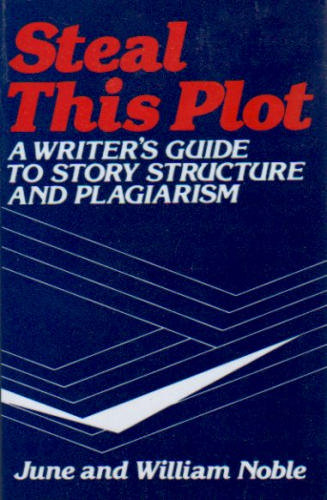
So, after all of these years of reading relatively serious fare (Roland Barthes anyone?) I picked up Steal This Plot, by June and William Noble, in a dog-eared, nearly bankrupt used book store, and it turned out to be one of the better "how-to-write" books I’ve read.

The caveat is that very few in the literary how-to genre have done me much good. Steal This Plot at the very least offers some archetypal plot structures to consider when writing any story. You don't have to steal the plot so much as you can think about the tendencies of your own storyline and consider the trajectory of other stories. If you're an undisciplined writer, and one who prefers to write without an outline, then Steal This Plot will surely help bring discipline to your storyline, and perhaps tame any wild tangents.

With its distinctions between plot spicers and plot motivators, it offers even experimental writers something to think about when constructing a narrative. I have to say that I think this book if more helpful than Francine Prose's Reading Like a Writer.

Here are the plot motivators:
  • vengeance
  • catastrophe
  • love and hate
  • the chase
  • grief and loss
  • rebellion
  • betrayal
  • persecution
  • self-sacrifice
  • survival
  • rivalry
  • quest
  • ambition.
Here are the plot spicers (sub-plots of a sort):
  • mistaken identity
  • criminal actions
  • deception, honor
  • increase or decrease in material well-being
  • authority
  • making amends
  • conspiracy
  • rescue
  • unnatural affection
  • suspicion
  • suicide
  • searching.

Good plots can be told repeatedly in endless variations, I hear.

Wednesday, January 17, 2007

Reading Like a Writer, by Francine Prose

“Can creative writing be taught?” That's the question Francine Prose starts with in her recent book, Reading Like a Writer.

The question, which is so often a taunt--a menace to the hundreds (thousands?) of creative writing programs across the nation--often looms in my mind. I suspect the answer is no. Talent can at best be refined and nurtured, but the true creative numen, that which startles, is revered or reviled, is ineffable, such a force unto itself that it can’t be explained or constructed by a classroom curriculum or any sort of regimen.

Still, some of us, the stubborn or the dumb, persist, hoping that we can teach ourselves something.

Prose’s recommendation is that we read more carefully, diagramming stories as we take pleasure in reading them, for only those who notice the techniques of the masters can possibly carry them off.

Reading Like a Writer is a solid book, if not particularly enlightening. I read it to attune my awareness more keenly to the finer narrative details, to shake myself up a bit, and the book delivered on that level. One would think that I’d pause more with age, carefully consider each book I read, but I find that as my hours for free reading get squeezed by what can only be called adulthood, I read with greater haste and sloppiness, deceiving myself that I can keep up the volume of reading I used to take for granted.

So now I remind myself to slow down, pay attention to the details. Here are a couple snippets I enjoyed from Prose’s book, and will try to teach myself:

On paragraphs
:
"The breaking up into paragraphs and the punctuation have to be done properly but only for the effect on the reader. A set of dead rules is no good. A new paragraph is a wonderful thing. It lets you quietly change the rhythm, and it can be like a flash of lightning that shows the same landscape from a different aspect." --Isaac Babel

Prose comments that paragraphs can be understood "as a sort of literary respiration, with each paragraph as an extended--in some cases, very extended--breath. Inhale at the beginning of the paragraph, exhale at the end. Inhale again at the start of the next."

On dialogue:
"When we humans speak, we are not merely communicating information but attempting to make an impression and achieve a goal. And sometimes we are hoping to prevent the listener from noticing what we are not saying, which is often not merely distracting but, we fear, as audible as what we are saying. As a result, dialogue usually contains as much or even more subtext than it does text. More is going on under the surface than on it. One mark of bad written dialogue is that it is only doing one thing, at most, at once."

Like good actors, who don't just act their part, but react to the actors and scene around them, Prose says, "a good writer understands that characters not only speak differently depending on whom they are speaking to, but also listen differently depending on who is speaking."

For more, read the New York Times fine review of the book.


Sunday, December 03, 2006

Ian McEwan's Supposed Plagiarism

Hurray for Charles Isherwood's astute piece in the New York Times on all of the fuss about Ian McEwan "plagiarizing" bits of Atonement from a memoir he'd used in his research.

With each plagiarism scandal, I've wondered what constitutes plagiarism, especially with a novel. Should a novel include footnotes? My, that would ruin the reading experience--make it much harder to suspend disbelief, as all novels require. So many other arts are granted the liberties and joys of appropriation, of riffing on someone else's melody at the very least, whether it's painting, rap, or jazz. Even movies can mirror past scenes, and steal plots unabashedly. But not writing. There's something too sacred about crafting a sentence, it seems.

Of course, McEwan wasn't appropriating to make any sort of artistic commentary. More accurately, he failed to pick up a thesaurus to mix in a few synonyms for several descriptions from this World War II nurse's memoir. The descriptions have nothing to do with the construction of his characters, dialogue, narrative design, or authorial voice--nothing to do with any of the crucial things that make a novel good. It's interesting to me that so many are willing to parse through such small matters, as if McEwan deserves no credit for his achievement because of this small lapse, if it's that.

It's so difficult and rare for an author to write a great book. So many things go into it. Why even bring up a few borrowed words--yes, borrowed, not plagiarized? I'm sure McEwan's transgressions could have gone much further before I'd ask for a trial. Even if he borrowed all of the words in the book from a 100 different sources, it would be quite an achievement to stitch it all together into such a fine book.

For more, read McEwan's defense of himself.

Tuesday, September 12, 2006

Susan Sontag

The excerpts of Susan Sontag's journals in last Sunday's Times revealed two interesting things about her: a tendency for self-loathing mixed with flashes of insight, especially on the nature of being a writer.

I suppose I know why self-loathing is such a frequent character trait of "greatness," at least if I play the role of an armchair psychologist. Susan Sontag obviously possessed such a powerful need to be accepted on a grand scale--she needed the accolades of brilliance as much as she needed the sustenance of brilliance--and so drove herself mightily and crazily to be a part of intellectual life in the city, and to merit high standing among its secular priesthood.

The excerpts from her journals provided a few good quotes on the nature of writing (and a couple of little life lessons) among the jims and jams of sorting out who she was and who she could be:

Writing and moralizing
"It’s corrupting to write with the intent to moralize, to elevate people’s moral standards."

Writing and egotism
"Why is writing important? Mainly, out of egotism, I suppose. Because I want to be that persona, a writer, and not because there is something I must say. Yet why not that too? With a little ego-building — such as the fait accompli this journal provides — I shall win through to the confidence that I (I) have something to say, that should be said."

Truth and time
"There is no stasis. To stand still is to fall away from the truth; the inner life dims and flickers, starts to go out, as soon as one tries to hold fast. It’s like trying to make this breath serve for the next one, or making today’s dinner do the work of next Wednesday’s as well. . . .Truth rides the arrow of time."

Fear of aging
"The fear of becoming old is born of the recognition that one is not living now the life that one wishes. It is equivalent to a sense of abusing the present."

The American struggle to write
"In every important modern American writer you feel a struggle with the language--it's your enemy, doesn't naturally work for you. (Completely different in England, where the language is taken for granted.) You have to subdue it, reinvent it."

It's certainly refreshing to hear any author recognize egotism as a motive for being a writer, not to mention the love affair with the persona of being a writer. All writers possess both, I'm convinced, as much as any trait.

Both characteristics have motivated me (without payoff, but with satisfaction). In fact, I yearn for the days when playing out the persona of a writer filled up my soul. It's always a wonderful feeling to be able to walk into a room with dashing hopes and reckless confidence, even if you don't have a product to show for it. The problem with age is that you need the product. No one will let you play pretend anymore. You can't say "I want to be a writer," because if you've wanted to be a writer, you should be one by now.